


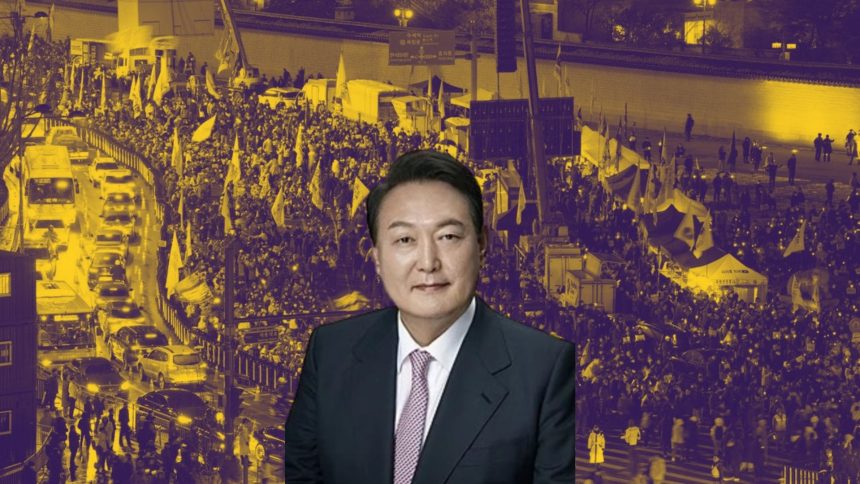
In a nation where the echoes of past uprisings still reverberate, South Korea finds itself at a pivotal crossroads. As the political landscape shifts dramatically, President stands on the precipice of an impeachment vote—an event that could reshape the country’s democratic fabric. The backdrop to this unfolding drama is steeped in controversy; recent measures imposing martial law have stirred deep anxieties among the populace, reigniting debates over civil liberties and governmental authority.
As both supporters and detractors mobilize, the nation watches with bated breath, aware that the outcome of this vote may define not only the immediate future of its leadership but also the essence of democratic resilience in the face of crisis. In this article, we delve into the complexities surrounding the impeachment proceedings and the implications of martial law, seeking to understand how South Korea navigates the delicate balance between authority and liberty in these tumultuous times.
South Koreas Political Turmoil and the Looming Impeachment Vote
As some noticeable political strife tangles the Republic of Korea, an imminent impeachment vote puts President Moon Jae-in at the center of a firestorm. Accusations of a potential martial law implementation have surfaced recently, sparking outrage and catapulting the country into a state of heightened political tension. In line with President Moon’s widely reported defiance to step down voluntarily, the decision now falls on the National Assembly’s shoulders, to scrutinize the allegations diligently.
Moon Jae-in, who first took office in 2017, was revered for his role in a peaceful transition of power following the impeachment of his predecessor. However, his popularity oscillates amid shaken trust, triggered by mishandling of economic affairs and ineffective policies. Adding to the existing disarray, claims of martial law instigation have not offered Moon any respite. The followng aspects of controversy involve:
- Rising unemployment
- Perception of economic mismanagement
- Public discontent over Moon’s North Korea policy
- Alleged plans to impose martial law
The impending impeachment vote casts a shadow of uncertainty over the political landscape in South Korea and intensifies the situation. The vote’s outcome will not only decide the President’s fate but will also map the country’s future political trajectory.
| Impeachment motion filled on | 25th November, 2021 |
| Accusations against the President | Administration’s failure to control soaring house prices, weak economy |
| Vote expected on | 14th December, 2021 |
| Vote outcome | To be decided |
Examining the Impact of Martial Law on Democratic Norms
In the shadow of a national crisis, South Korea faces a period of political instability as President Park Geun-hye finds herself on the brink of impeachment. Accused of allowing a close friend to profit from her political position, Park’s alleged misconduct comes amidst controversy over whether the current government has manipulated the resilience of martial law, an archaic provision from South Korea’s authoritarian past, in a bid to safeguard their own tenure.
Decoding Martial Law
- Exploring roots: Martial law traces its roots back to the era of military dictatorship (1961-1987) in South Korea. It granted the military sweeping powers to enforce laws, preserve peace and carry out justice.
- Use or misuse? Over time, however, the provision has often been misused by governments to suppress political dissenters, thus undermining democratic norms and principles.
Impact of Martial Law on Democratic Norms
| Aspect | Impact |
|---|---|
| Civil liberties | Severe curtailing of individual freedom, privacy, and speech, leading to a chipped away at human rights. |
| Press Freedom | Heavy censorship resulting in a controlled media that curbs the free exchange of ideas and information. |
| Justice system | Returns the power of dispensing justice into the hands of the military, leading to potential abuse of power and miscarriages of justice. |
As South Koreans watch their President fight the scourge of impeachment, deep-seated fears emerge regarding the alleged utilization of martial law as a means to retain power. This fear does not merely represent a criticism of the incumbent, but a broader concern about the durability of democratic norms within the nation. It is an apprehension of slipping back into an autocratic past, underscoring the need for political accountability and transparency in the nation’s governance.
Public Sentiment and the Role of Civil Society in Political Accountability
In a dramatic turn of events, South Korea now finds itself embroiled in a political minefield after the proposition of a martial law bill sparked nationwide protests. The move to impeach South Korean President Lee Myung-bak took a leap forward amid growing public sentiment demanding greater transparency and accountability from the government. Public unrest has been further intensified by a proposal previously unseen since the country’s dark dictatorial past – one that seeks to impose Martial Law.
What is remarkable in these developments is not just the potent public sentiment but also the significant role played by Civil Societies. They’ve proved to be instrumental in guiding the masses towards holding the government accountable for its actions. Organizations are resorting to mediums like street protests, signature campaigns, social media activism, and public debates to voice their discontentment.
- Street Protests: Large scale public gatherings, reminiscent of the candlelight vigils of 2002, are being held to voice dissent.
- Signature Campaigns: Petitions signed by millions are pressuring the government into withdrawing the martial law bill.
- Social Media Activism: Social media is being utilized as a tool to rally support and disseminate information swiftly.
- Public Debates: Debates are being held to discuss the possible implications of the martial law and its effect on the democracy of the country.
Another significant strategy is the use of litigation and the press to push for transparency. This particular strategy has brought the irregularities and unconstitutional actions of the government right into the public spotlight. With an outpour of information from the media and relentless pursuit by Civil society, the government stands cornered, and the call for impeachment is getting louder.
| Initiatives | Impact | |
| 1 | Public Protests and Demonstrations | Pressure on the government to withdraw the martial law bill. |
| 2 | Media Exposures | Expose Government’s unconstitutional actions |
| 3 | Social Media Campaigns | Rapid dissemination of information and rallying support. |
Recommendations for Navigating the Constitutional Crisis Ahead
South Korea’s President is currently facing an impeachment vote amid a swirling controversy about the implementation of martial law. To navigate this constitutional crisis, a few recommendations must be taken into account.
Firstly, it is essential for the citizens of South Korea to fully understand the depth and breadth of the situation, along with its potential impacts. Fully cognizant citizens are often the prime drivers of a democratic and robust public discourse. Harnessing the power of social media and other digital mediums to educate and inform can be an effective strategy.
- Stay Informed: Keep up-to-date with developments as they unfold and take the time to understand the constitutional, political, and socio-cultural ramifications of the impeachment vote.
- Critical Engagement: Engage constructively with news, government narratives, opinion pieces, and even fake information. Ask questions, demand answers, and hold accountable those in positions of power.
- Active Participation: Participate in peaceful protests, online rallies, and other civil society activities focused on calling for transparency, fairness, and justice.
Secondly, the international community has a glancing role to play. Advocacy for democratic norms and values, maintaining open and constant communication channels, and stringent monitoring mechanisms can be beneficial.
| Global Engagement | Engaging South Korea on this issue in international forums |
| Dialogue | Maintain open channels of communication with the South Korean government |
| Monitoring | Monitor the situation and report any instances of human rights abuses |
Navigating through a constitutional crisis requires both internal resilience and external support. As South Korea walks this tightrope, informed citizens and a proactive international community can help maintain the balance.
The Conclusion
As South Korea stands at a crossroads, the unfolding drama of President’s impeachment vote serves as a potent reminder of the delicate balance between governance and the will of the people. The backdrop of martial law raises profound questions about civil liberties and the limits of authority. As legislators prepare to cast their votes, the nation holds its breath, aware that the outcome could reshape the political landscape for years to come.
Whatever the result, this moment will undoubtedly resonate in the annals of South Korean democracy, illustrating both the complexities of leadership in turbulent times and the enduring spirit of a populace determined to assert its voice. As the sun sets on this chapter, one thing remains clear: the story of South Korea’s political evolution is far from over.


